This question shows up constantly in home design forums, and it almost always gets framed the same way: which one should I do? Homeowner has a budget, has a house that looks flat and dark at night, and is trying to pick a lane.
Here's the thing nobody tells you until after you've already spent the money: those two things aren't competing for the same job. Choosing between them is a little like choosing between a ceiling fan and a couch. Both go in the living room. They are not alternatives.
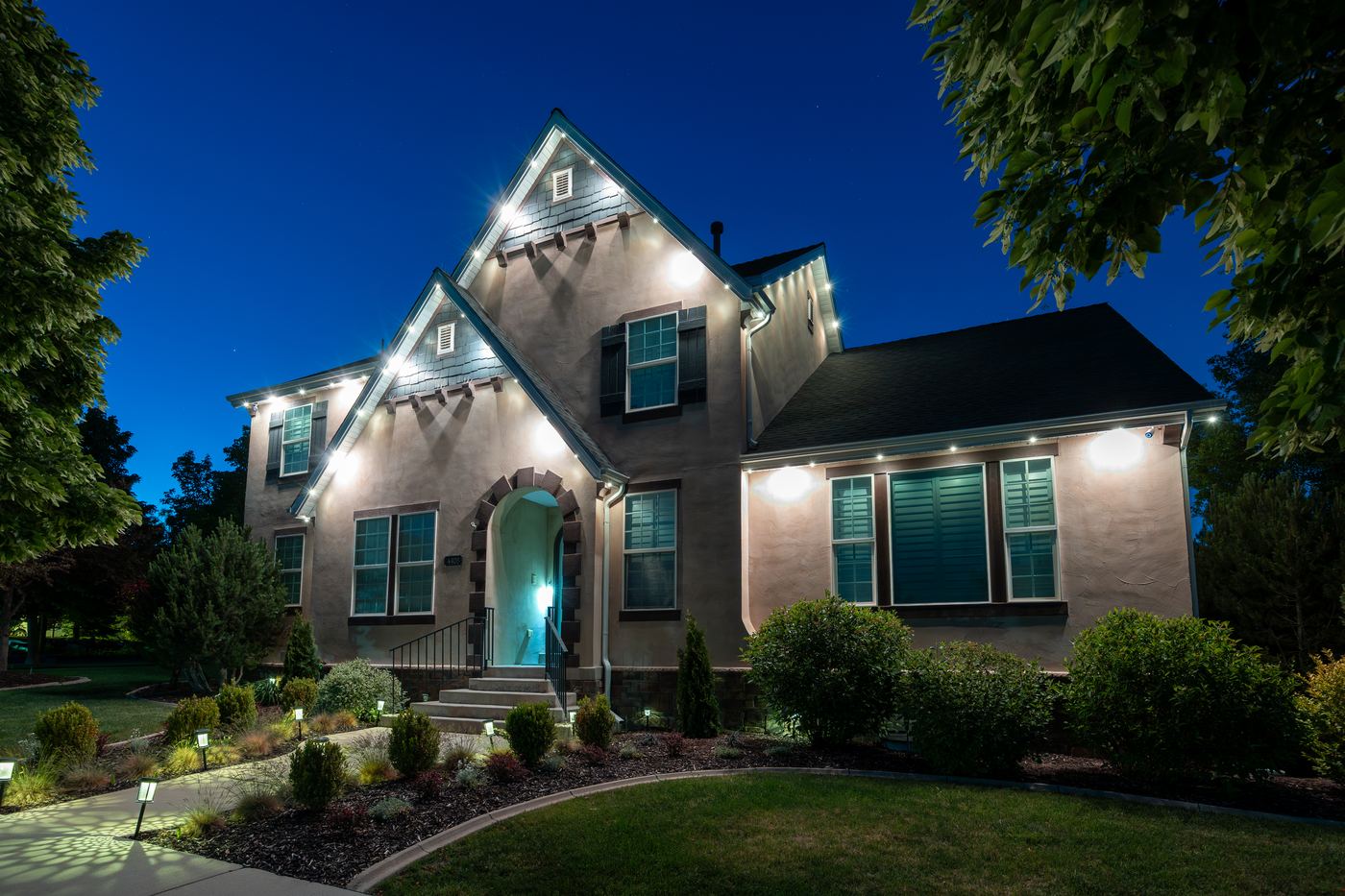
Traditional exterior lighting illuminates your home — it points light at the house and yard so you can actually see architecture, landscaping, and walkways. Permanent Christmas lights outline your home — they sit at the roofline pointing outward, creating color and shape against the night sky. If your goal is "my house looks better every night," you want traditional. If your goal is "I never want to hang Christmas lights again," you want permanent. Most homes that look genuinely great at night have both.
What "Traditional Exterior Lighting" Actually Means
It's a broad bucket, and that vagueness is part of why the comparison gets muddled. When most people say traditional exterior lighting, they mean some combination of:
- Soffit and down lighting — fixtures recessed into the eaves that wash light down the face of your home. This is the single biggest visual upgrade for most Florida houses, and it's the one people underestimate.
- Landscape lighting — uplights on palms and oaks, wash lights on hedges, path lights along the walkway. This creates depth. Without it, a lit house looks like a lit house floating in a black void.
- Wall sconces and entry fixtures — the lights flanking your garage and front door. Functional, usually builder-grade, rarely enough on their own.
All of it is generally fixed-color (warm white), always aimed inward or downward, and designed to be on every night. It's the lighting equivalent of good landscaping — you don't notice it consciously, you just think the house looks expensive.
What Permanent Christmas Lights Actually Are
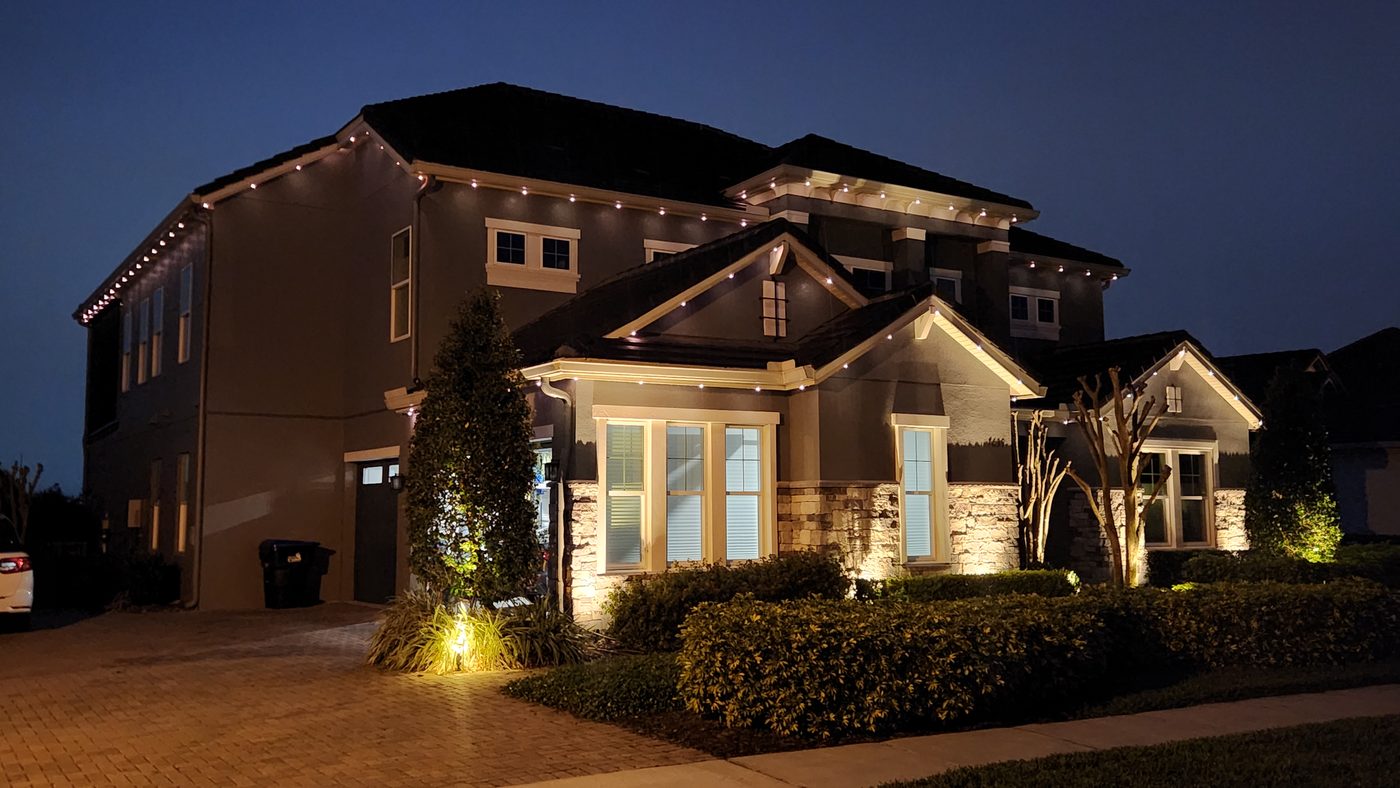
The category name is doing this product a disservice. Permanent holiday lighting is a track of individually addressable RGB LED nodes seated in a color-matched aluminum channel, installed under your trim line. Wiring is hidden. A controller and a phone app drive it.
What that gets you:
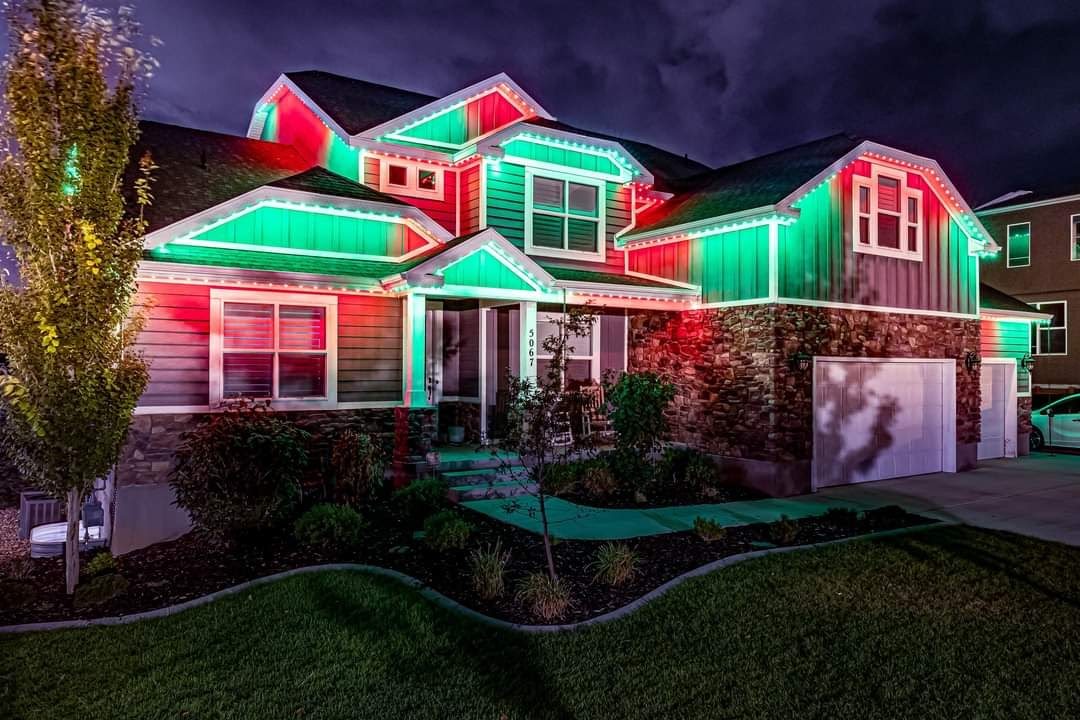
- Any color, any zone, any pattern — programmed from your phone
- Scheduling, so it runs on sunset triggers without you touching it
- Warm white mode for ordinary nights, so it isn't only a holiday product
- No ladder, no storage bins, no tangled strands, no annual install fee
What it does not get you: a lit walkway, lit landscaping, or a lit front door. The lights face out toward the street. They define the shape of your roofline beautifully. They do not illuminate your property.
The Overlap Is Smaller Than You Think
Break it into the four jobs exterior lighting is actually hired to do, and the picture clears up fast:
| The job | Traditional | Permanent holiday |
|---|---|---|
| Make the façade and architecture visible | Yes — this is its primary purpose | No — light points away from the house |
| Light walkways, driveway, entry | Yes | No |
| Show off landscaping and trees | Yes | No |
| Holiday color and seasonal display | No | Yes — the entire point |
| Define roofline shape from the street | Partially | Yes |
| Eliminate annual Christmas light labor | No | Yes |
| Deterrence / occupied-home appearance | Yes | Yes (scheduled warm white) |
Two rows of genuine overlap out of seven. That's why "which one" is the wrong question — and why homeowners who install only permanent lighting sometimes feel a little let down in February. The house has a beautiful glowing outline and a pitch-black yard underneath it.
Where Permanent Lighting Genuinely Replaces Something
There is one place the either/or framing holds up: permanent holiday lighting absolutely replaces seasonal string lights, whether you hang them yourself or pay someone.
Around Central Florida, a professional seasonal install-and-remove typically runs several hundred to well over a thousand dollars a season depending on roofline complexity and story count — and that money is gone every January. Do it yourself and the cost moves from your wallet to a Saturday on a ladder, plus storage space, plus replacing a third of the strands every couple of years because Florida sun and summer storms are hard on them.
Run that out five or ten years against a one-time install and the math gets uncomfortable for the seasonal option. We break the numbers down in more detail on the Florida permanent holiday lighting cost page, and financing is available if you'd rather spread it out.
The Central Florida HOA Rule Most People Miss
This is the part that surprises homeowners in Winter Garden, Windermere, Horizon West, Lake Nona, and most of the master-planned communities around Orlando — and it's a real argument in favor of doing both.
Many local ARC (Architectural Review Committee) guidelines for front exterior lighting read something like this:
- Wiring must not be visible; channel and hardware must color-match the structure
- Lighting is limited to the front façade, typically no more than 10 feet past each side
- Light must project onto your own property — no spill past the property line
- LED fixtures capped around 4 watts, spaced a minimum distance apart
- A single white shade on any given day, except on recognized holidays
- No chasing, fading, twinkling, or flashing effects outside of set holiday windows
- Christmas color permitted roughly from Thanksgiving Day through early-to-mid January
Read that carefully. Under guidelines like these, your permanent system spends the large majority of the year running solid warm white with no effects — which is to say, functioning as traditional exterior lighting on your roofline. It also means color isn't your everyday differentiator. What makes the house look good on a random Tuesday in April is the down lighting and the landscape lighting.
The flip side: a programmable system is easier to keep compliant than string lights, because you schedule the holiday windows once and it self-enforces. That's frequently why boards approve permanent systems. Ours ships with documentation built for exactly this conversation — see the HOA packet.
Worth saying plainly: guidelines vary community to community, and the rules above are a common pattern, not a universal standard. Pull your own community's ARC document before you plan anything. We'll help you read it.
If You Can Only Do One Right Now
Budget is real. Here's how we'd actually advise it, and note that the answer depends on what's bugging you:
Start with traditional if…
- Your house looks flat, dark, or invisible from the street after sunset
- You've spent money on landscaping nobody can see at night
- The walkway or entry feels unsafe or unwelcoming
- You genuinely don't care much about holiday display
Start with permanent holiday lighting if…
- You're already paying someone to hang lights every December
- You're on a ladder every year and you'd like to stop
- You have a two-story, steep pitch, or complex roofline (the labor cost compounds fastest here)
- Holidays are a big deal in your house and you want more than Christmas
One practical note: if you're doing both eventually, there's a real efficiency argument for doing the roofline work — soffit down lighting and permanent track — in the same visit. Same lift, same crew, same access. Splitting them across two years means paying for setup twice.
What We'd Recommend for a Typical Orlando Home
The layered approach, in order of visual payoff:
- Soffit down lighting across the front façade. This is the foundation. It's what makes a house read as intentionally lit rather than just having a porch light on.
- Landscape uplighting on the specimen trees and structural plantings. Adds depth and dimension so the house isn't floating.
- Permanent roofline lighting for holiday color, game days, and a clean warm white outline the rest of the year.
- Pool cage, lanai, or outdoor audio if the back of the house is where you actually live — which in Florida, it usually is.
Done together, those systems don't compete — they stack. The down lighting handles the walls, the landscape lighting handles the ground, the roofline handles the sky. Go look at the residential gallery and you'll notice the homes that stop you are almost never running one system alone.
Frequently Asked Questions
The Bottom Line
Stop treating it as a fork in the road. Traditional exterior lighting is how your home looks on the other 325 nights of the year. Permanent holiday lighting is how it looks on the 40 that your family will photograph. One is infrastructure, the other is expression, and the homes that look best have both working together.
If you're anywhere in greater Orlando — Winter Garden, Windermere, Horizon West, Dr. Phillips, Clermont, Lake Nona, Winter Park, Oviedo — we'll come out, walk the property after dark, and show you exactly what each layer does on your house before you spend a dollar. That demo is free and there's no obligation attached to it.